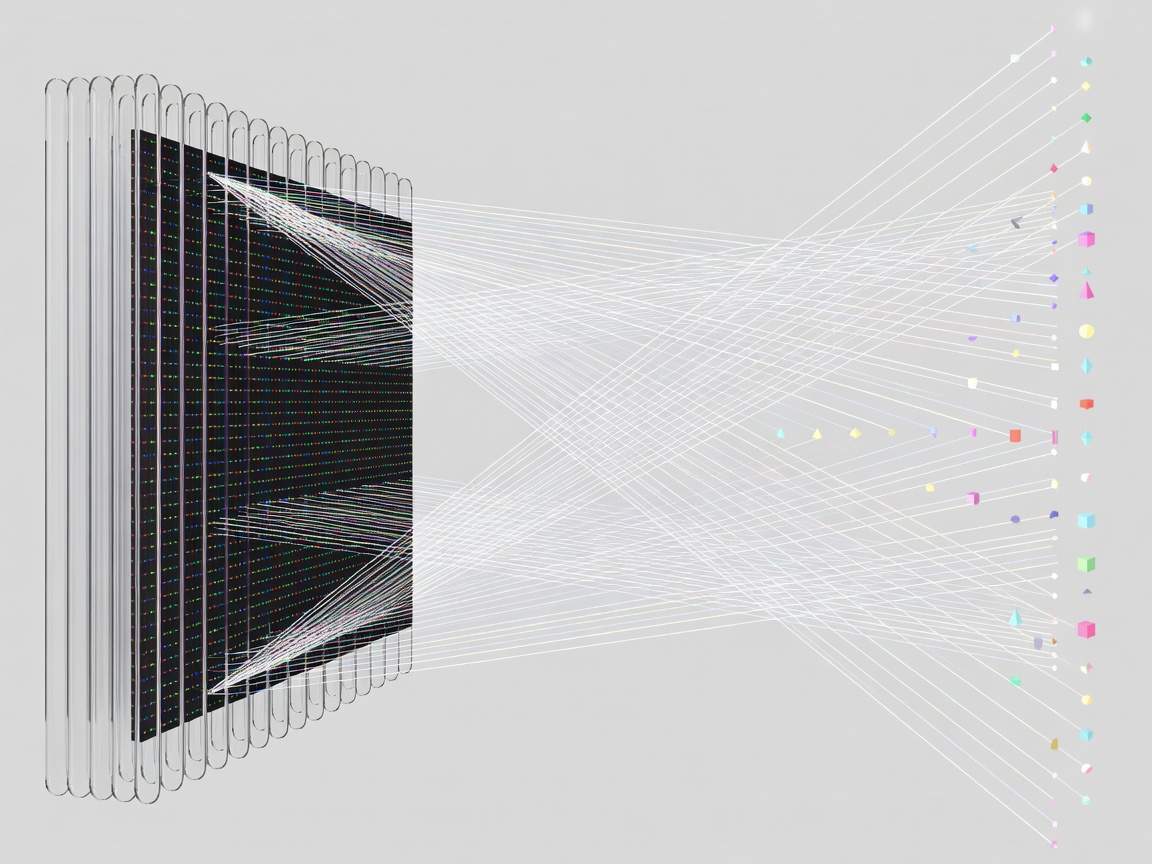
While head-mounted spatial computing requires users to wear external hardware, holographic and light field displays pursue a frictionless ideal: true, glasses-free three-dimensional visualization. Achieving this requires monumental leaps in optical engineering and pixel density manipulation.
Light Field vs. Lenticular Displays
Most consumer "3D screens" rely on lenticular lenses—small ridges over a traditional LCD that direct different pixels to the left and right eyes. While effective for basic stereoscopic depth, lenticular displays have narrow viewing angles, lack vertical parallax, and cause eye strain due to the vergence-accommodation conflict.
Light field displays, championed by companies like Looking Glass Factory and Light Field Lab, take a fundamentally different approach. Instead of rendering two views, they project dozens or hundreds of distinct angular views simultaneously. As a viewer moves their head, their eyes naturally intercept different sets of light rays, allowing them to look around objects in the display.
The Pixel Density Bottleneck
The primary barrier to scaling light field technology is the sheer number of pixels required. To generate 100 distinct viewing angles for a standard 4K image, the underlying panel must theoretically push 100 times the pixel count of a 4K monitor.
- Sub-pixel Multiplexing: Manufacturers employ dense micro-lens arrays over ultra-high-resolution panels to bend light precisely.
- Bandwidth Constraints: Feeding data to these panels requires proprietary rendering pipelines. Standard HDMI and DisplayPort connections lack the bandwidth to transmit true uncompressed volumetric video at 60 frames per second.
Software Render Pipelines
Creating content for holographic displays shifts the burden from simple 2D rendering to multi-view rendering. Standard 3D engines (like Unreal Engine and Unity) use specialized plugins that capture a scene from multiple virtual cameras simultaneously. These slices are interlaced into a format the hardware can decode—often a quilt-like layout of views.
With the rise of NeRFs (Neural Radiance Fields) and Gaussian Splatting, generating these multiple views has become significantly more efficient. Neural rendering allows algorithms to interpolate between captured views, enabling real-time holographic streaming with lower initial capture requirements.
Current Viability and Future Outlook
Currently, true holographic displays are priced for enterprise use cases: medical imaging, automotive design reviews, and high-end retail installations. As micro-LED manufacturing matures and compute costs decrease, we project multi-view light field displays will slowly replace standard professional monitors, particularly in 3D modeling and architecture workflows.