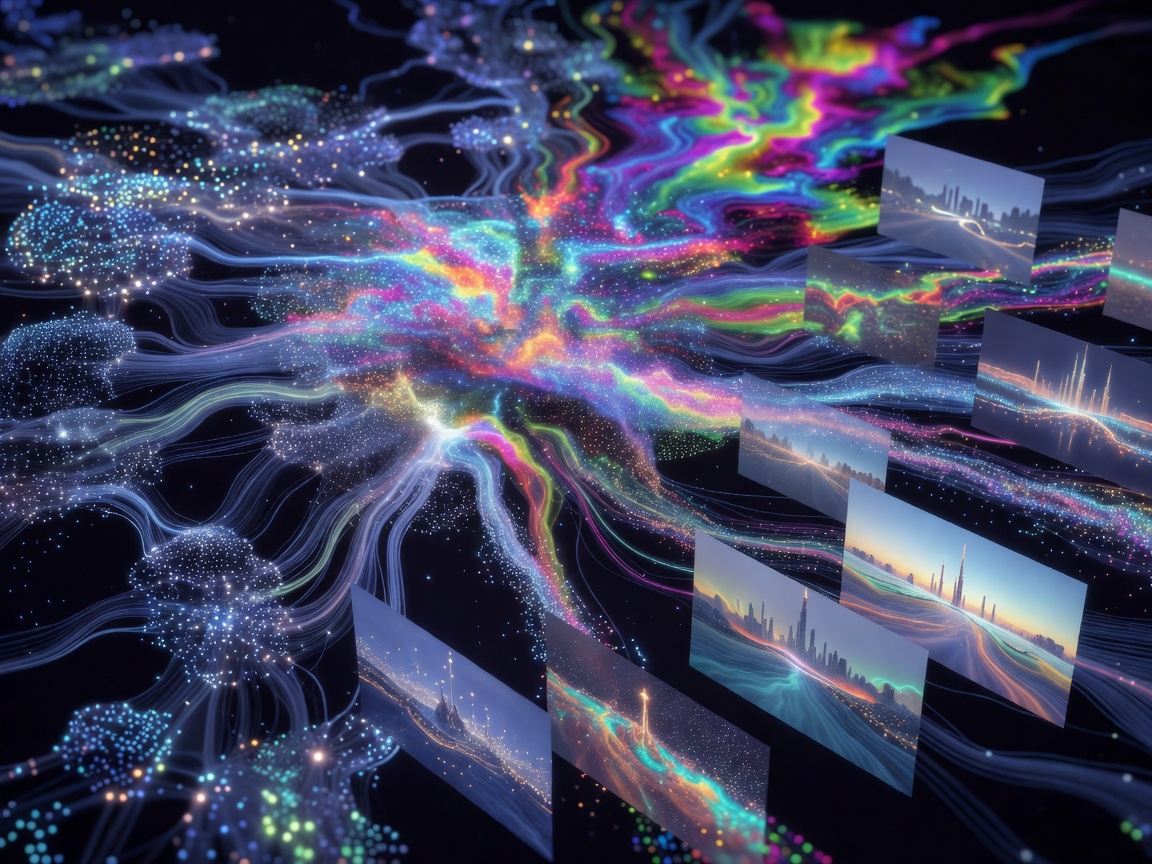
The leap from text-to-image to text-to-video represents an exponential increase in computational complexity. While image generation models like Stable Diffusion construct a single 2D latent space representation, video models must account for a third dimension: time. This added axis introduces the formidable challenge of temporal consistency.
The Architecture of Video Generation
Modern video generation platforms, such as OpenAI's Sora, Runway Gen-2, and Pika Labs, rely on advanced diffusion models combined with transformer architectures. Instead of predicting noise in a static image, these models evaluate patches of space-time.
Sora, for example, processes video by breaking it down into localized patches—much like how Large Language Models (LLMs) break text down into tokens. By tokenizing video into these multidimensional patches, the model can synthesize novel sequences that adhere strictly to physical laws learned during its massive training phase, resulting in outputs that mimic real-world camera physics and object permanence.
The Temporal Consistency Challenge
Early video AI was plagued by extreme morphing—objects would change shape, textures would boil, and subjects would lose their identity from one frame to the next. Achieving temporal consistency means ensuring that a subject remains visually identical across the timeline, even when obscured or viewed from different angles.
Current Solutions:
- Cross-Frame Attention Mechanisms: Modern models force the attention layers to reference not just the current frame's noise, but the latent representations of previous and future frames.
- ControlNet Integration: In professional workflows, depth maps and optical flow maps are fed into the network to lock down the structure of the scene.
- Motion LoRAs: Low-Rank Adaptations trained specifically on specific types of motion (e.g., "slow cinematic pan" or "running water") help guide the diffusion process.
Compute Requirements & Inference Costs
Generative video is notoriously compute-hungry. Training a state-of-the-art video model requires clusters of thousands of high-end GPUs (like NVIDIA H100s) running for months. However, the bottleneck for widespread adoption lies in inference—the compute required to generate a video for a user on demand.
Generating a single minute of high-fidelity, 1080p AI video currently can take anywhere from several minutes to hours depending on the architecture and the sampling steps required. As a result, commercial APIs heavily meter usage, and local generation is restricted to users with massive VRAM allocations (24GB+ minimum for standard consumer workflows).
Integration into Professional Workflows
Despite limitations, studios are rapidly integrating generative AI into pre-production and VFX. Instead of replacing full-scale productions, AI video excels in storyboarding, generating background plates, and producing complex fluid or particle simulations that would take weeks to render traditionally.
The focus over the next hardware generation will be optimizing these models for real-time inference, paving the way for dynamic, AI-generated environments in interactive media and spatial computing applications.